 My Second Life
- Section
- 01 Healthy
- Reading
- 9 min
- Published
The Spotlight Problem
Thinning hair, a daily pill, and the line I won’t cross.


Every man who says he doesn’t care about losing his hair is either lying or already through the grieving. I’m not in either camp. I’m somewhere in the middle, and if you’re reading this, you probably are too.
I want to be clear about what this piece is and isn’t. It isn’t a cure. It isn’t a sales pitch. It’s a field report from a middle-aged man who has noticed his hair changing, tried one fix that didn’t do much, has just started a second, and has decided in advance where he stops. I’ll report back on how it goes. Hair grows slowly, so this is going to be a long-running series.
What the mirror is telling me
Grey isn’t the problem. I made my peace with grey years ago. A bit of salt and pepper suits a man of a certain age, and nobody has ever lost a contract for looking like he has some miles on the clock.
What’s changed is the hair itself. The strands are finer. There’s less body to it. It doesn’t have the shine it used to have, and it doesn’t sit the way it used to. Run your fingers through it and there’s simply less there. Not bald. Not even close. But not what it was.
It turns out those are two completely different processes, and it’s worth separating them.
Greying is a pigment problem. The stem cells that supply colour to each follicle gradually run down, and the hair grows in without pigment. The follicle itself is fine. The hair is still there. It’s just white.
Thinning is a follicle problem, and the culprit has a name: androgenetic alopecia, or male pattern baldness. Testosterone is converted by an enzyme called 5-alpha reductase into dihydrotestosterone, or DHT. In men who have inherited the susceptibility (and most of us have, to some degree), follicles on the crown and the front of the scalp are sensitive to DHT. Over successive hair cycles, the growth phase gets shorter and the follicle itself shrinks. Each new hair comes back a little finer, a little shorter and a little lighter than the one before. Dermatologists call it miniaturisation. A thick, healthy hair slowly becomes a wisp.
This explains exactly what I’ve been seeing. The number of hairs can hold up for a long time while each individual hair carries less. Finer hairs mean less volume. Less volume means less light bounced back off the hair and more light reaching the scalp. That’s the loss of lustre. That’s the scalp showing through.
None of this is unusual. Norwood’s classic survey found that roughly half of men show some degree of pattern hair loss by fifty. And note the hair at the back and sides of the head. It’s largely immune to DHT, which is why even very bald men keep a horseshoe. Hold that thought. It matters later.
The spotlight problem
Here’s the part that’s harder to admit.
I’ve become conscious of light. Specifically, overhead light. A bright downlight in a lift. Spotlights in a restaurant. A stage, a conference podium, a bathroom with a mirror lit from directly above. Light from above passes straight through thinning hair and lands on the scalp, and suddenly what looks perfectly respectable in normal light looks like a problem. So I’ve caught myself shifting half a step to one side so I’m not standing directly under it. Every time. Without really thinking about it.
And the wind. Step outside on a windy day and the first thing I do once I’m back indoors is check my hair. Car window, phone camera, any reflective surface I can find. Has it parted in the wrong place? Is the crown on show?
The real cost isn’t the hair. It’s the attention.
I know how this sounds. It’s vanity, and it’s irrational. Nobody is looking at my scalp as hard as I am. If a younger colleague told me he was doing this, I’d tell him to stop wasting a single second on it. I do it anyway.
I’m not alone, and it isn’t trivial. Thomas Cash’s research on men with androgenetic alopecia in the early 1990s found that hair loss was commonly associated with preoccupation, feeling older and feeling less attractive, and that men with relatively modest loss reported the same distress. The real cost isn’t the hair. It’s the attention. Every half-step away from a spotlight and every glance at a car window is a small tax on your focus, paid over and over again. That alone is reason enough to act.
Microneedling: the experiment that didn’t pay off
My first move was the least invasive option with some science behind it: microneedling.
The idea is simple. A dermaroller or derma pen pushes fine needles into the scalp, making thousands of tiny, controlled wounds. The theory is that the wound-healing response releases growth factors and switches on signalling pathways linked to hair growth, and that the micro-channels help topical treatments get into the skin.
The headline study is impressive. In 2013, Rachita Dhurat and colleagues in Mumbai randomised 100 men with androgenetic alopecia to twelve weeks of either minoxidil alone or minoxidil plus weekly microneedling. Mean hair count rose by 91.4 in the microneedling group against 22.2 with minoxidil alone. 82 per cent of the microneedled men felt they’d seen more than a 50 per cent improvement, against 4.5 per cent on minoxidil alone.
Read the caveats before you buy a roller. It was a small pilot study at a single centre. And crucially, microneedling wasn’t tested on its own. It was tested on top of minoxidil. Most of the trials since then follow the same pattern, pairing it with minoxidil or platelet-rich plasma. The evidence for microneedling by itself is thin.
That matched my experience. I’ve been using a 1.5 mm derma roller on my scalp every two or three days for about a year, but the result has been limited. Maybe a little less shedding, maybe nothing at all, and nothing I’d put my hand on my heart and call progress.
The lesson is the same one I took from creatine. A tool that multiplies a treatment isn’t a substitute for the treatment. Microneedling may well boost a drug. On its own, it’s mostly sore scalp.
Why finasteride
So I’ve gone to the drug that goes after the cause.
Finasteride blocks the type II form of 5-alpha reductase, the enzyme that turns testosterone into DHT. Less conversion, less DHT, less pressure on the follicles. According to the Propecia prescribing information, a single 1 mg tablet suppresses serum DHT by about 65 per cent within 24 hours. It doesn’t fight the symptoms. It turns down the signal that causes them.
The evidence is decades deep. Merck’s original placebo-controlled trials enrolled 1,879 men aged 18 to 41.
- At one year, men on finasteride had 107 more hairs than the placebo group in a one-inch diameter circle on the scalp.
- At two years, 17 per cent of the finasteride men had lost hair from baseline, against 72 per cent on placebo.
- At five years, it was 35 per cent against 100 per cent.
Caveat: by year five the placebo group had shrunk to just 15 men, so treat that last number as directional. But the direction is unmistakable. Untreated, pattern hair loss is progressive. On finasteride, most men stop losing ground, and many gain some back.
The obvious objection for anyone past forty: those trials were done on younger men. Fair point. A separate two-year placebo-controlled trial, published by Whiting and colleagues in 2003, looked specifically at men aged 41 to 60 and found the drug still worked. Older follicles still respond. They just have less to work with, which is an argument for starting sooner rather than later.
Now the side effects, because you’ll hear about them and you should know the actual numbers. In the twelve-month trials, drug-related sexual side effects (lower libido, erectile dysfunction, ejaculation problems) were reported by 3.8 per cent of men on finasteride against 2.1 per cent on placebo. That’s an excess of under two men in a hundred. In the trials, those effects resolved in men who stopped the drug. But there’s also a body of reports of sexual side effects that persist after stopping, plus reports of depression. In 2024, the UK’s MHRA introduced a patient alert card for finasteride covering sexual dysfunction, depression and suicidal thoughts, and in May 2026 it strengthened the warnings again. Their advice is to stop and seek medical advice if your mood changes. I’m taking that seriously, and I’d urge you to do the same. Know the signals and keep an eye on yourself.
One practical point that echoes my creatine piece. Finasteride lowers PSA, the blood marker used to screen for prostate cancer. Any middle-aged man having PSA checks needs to tell his doctor he’s taking it, so the reading can be interpreted properly and a real rise doesn’t get missed.
Why Hims? Friction. An online consultation, a prescriber who reviews it, and the pills turn up on a subscription. That matters more than it sounds, because finasteride only works while you take it. The prescribing information is explicit: stop, and the gains reverse within twelve months. This is a daily habit for the long haul, not a course of treatment. Anything that makes it automatic is worth having.
Not instant: how I’ll keep score
Finasteride is slow. Hair grows in cycles lasting months to years, and the drug has to work through those cycles. Here’s the realistic timeline.
- Three months: the earliest you might notice anything, mostly less shedding. Some men report a temporary increase in shedding early on, as weaker hairs make way for new growth.
- Six months: the first fair checkpoint.
- Twelve months: the real verdict.
So I’m keeping score the way I kept score on my running. One method, no fiddling with it.
- Baseline photos of the crown and hairline, taken on the 25th of October, 2026.
- Same spot, same camera, same light, every month. And yes, the irony isn’t lost on me: the most honest light is a harsh overhead light, the exact spotlight I’ve been avoiding. For once, I’ll stand right under it on purpose.
- Judge the trend, not the day. Hair looks different depending on whether it’s freshly washed, how humid it is and how you’ve styled it. One photo proves nothing. Twelve in a row do.
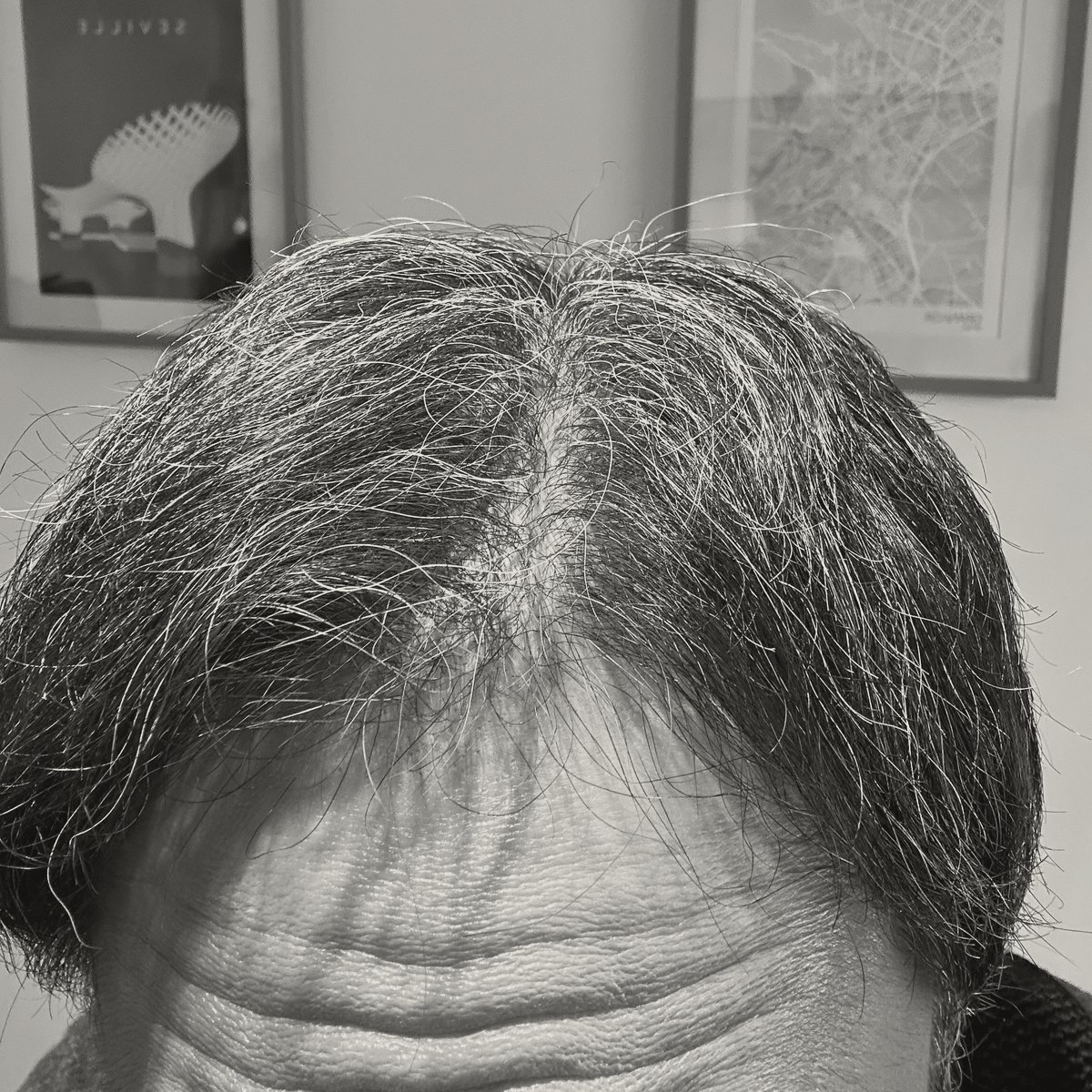
I’ll report back at three, six and twelve months. Good or bad.
Where I draw the line
No hair transplant. Not now, not later.
Let me give the strongest argument against my position first, because it’s a good one. Modern follicular unit extraction is very good. The results, done well, look natural. It’s done at enormous scale, it’s affordable, and it’s permanent in an important sense: the transplanted follicles come from the back of the head, the DHT-resistant horseshoe I mentioned earlier, and they keep their resistance when they’re moved. I know men who’ve done it and don’t regret it for a moment. If you want to go that way, I’m not going to talk you out of it.
But it’s not for me, for two reasons.
First, I draw a hard line at elective surgery for cosmetic reasons on a healthy body. Anaesthetic, incisions, recovery and scarring, all for vanity. That’s not a trade I’m willing to make.
Second, and this is the point most people miss: a transplant doesn’t cure anything. It moves hair around. The native hair surrounding the grafts keeps miniaturising on exactly the same schedule as before, which is why surgeons routinely recommend finasteride alongside a transplant to protect what you still have. So even if you take the surgical route, you very likely end up on the pill anyway. The transplant just front-loads the cost, the risk and the scars, and draws on a donor supply that’s finite.
The pill is the foundation. Surgery is an option you can stack on top. I’m building the foundation and stopping there.
And if the foundation doesn’t hold? Then I’ll buy a decent set of clippers, take it down to a number two, and walk straight under the spotlight. There’s nothing wrong with that.
Which brings me back to where I started. The goal was never the hair I had at thirty. The goal is to stop the half-step away from the light. Either finasteride buys me that, or the clippers will.
Sources
- Norwood OT. “Male pattern baldness: classification and incidence.” Southern Medical Journal, 1975;68(11):1359–1365.
- Cash TF. “The psychological effects of androgenetic alopecia in men.” Journal of the American Academy of Dermatology, 1992;26(6):926–931.
- Dhurat R, Sukesh M, Avhad G, et al. “A randomized evaluator blinded study of effect of microneedling in androgenetic alopecia: a pilot study.” International Journal of Trichology, 2013;5(1):6–11.
- Kaufman KD, et al. “Finasteride in the treatment of men with androgenetic alopecia.” Journal of the American Academy of Dermatology, 1998;39(4 Pt 1):578–589.
- Whiting DA, et al. “Efficacy and tolerability of finasteride 1 mg in men aged 41 to 60 years with male pattern hair loss.” European Journal of Dermatology, 2003;13(2):150–160.
- PROPECIA (finasteride) 1 mg prescribing information: clinical studies, adverse reactions, PSA and discontinuation sections.
- MHRA. Finasteride: patient alert card and Drug Safety Update, 2024; and “MHRA strengthens safety warnings for finasteride and dutasteride”, 11 May 2026.