 My Second Life
- Section
- 01 Healthy
- Reading
- 8 min
- Published
- Sep 2026
Cardio Training: Seven Heartbeats Slower
How four minutes of controlled suffering, a lot of slow miles and a handful of treadmill sprints rebuilt my engine.
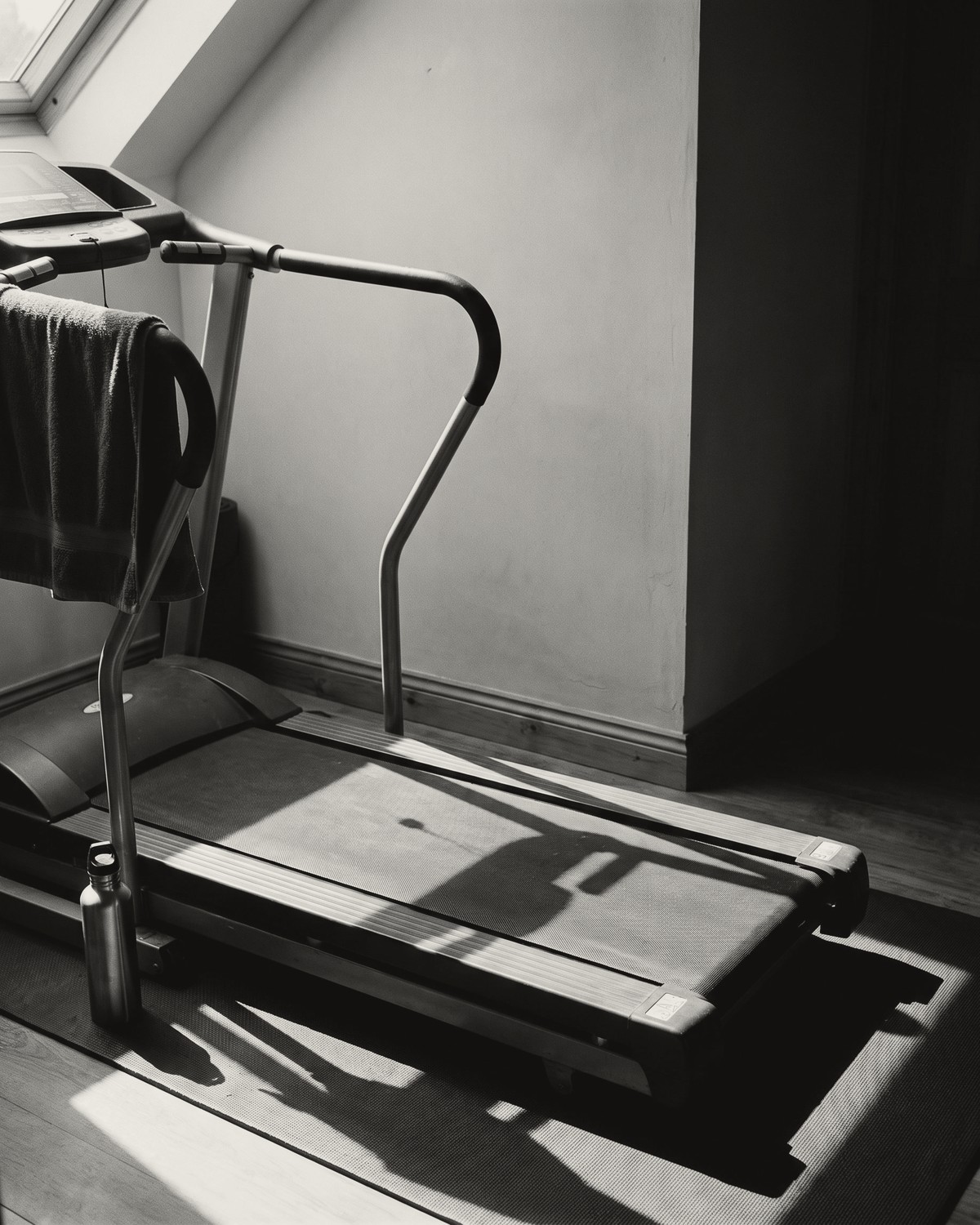

Minute three of the fourth interval is a particular place, and after four months I can describe it precisely. The legs are full of lead. The lungs work like a blacksmith’s bellows. And a voice arrives in the head — calm, reasonable, very nearly kind — to observe that three and a half efforts is essentially four, that whatever adaptation was going to happen has surely happened by now, and that nobody will ever know.
The voice is wrong. It is also the most persuasive thing in the building.
A man in his fifties arguing with a voice on a treadmill needs some account of himself. Mine is unremarkable. I have children, and I would like to meet whatever grandchildren arrive still able to get down on the floor with them and back up again without making a production of it. What the fourth repetition buys is not simply years. It is healthspan — the part of a life spent upright and useful, as against the part merely spent — and those are not the same thing.
What it is arguing with takes forty minutes and contains sixteen minutes of actual work. Ten minutes of easy warm-up, building towards moderate. Four minutes hard, at ninety to ninety-five per cent of maximum heart rate. Three minutes of jogging at around seventy. Then again, and again, and again, until four hard efforts are done, and five or ten minutes easy to wash out. Once a week, every week.
It is called the 4x4, and it came out of Jan Helgerud and Ulrik Wisløff’s group at the Norwegian University of Science and Technology, in Trondheim.
In Helgerud’s 2007 trial, forty moderately trained men were split across four programmes with the total workload matched, so that the only thing that differed was how the work was arranged.1 In eight weeks, long slow running did not move maximal oxygen uptake — the ceiling on how much oxygen a body can take in and use. Neither did running at lactate threshold, the pace you could hold for about an hour. The men doing four-minute intervals improved theirs by 7.2 per cent. The same Trondheim group reported, in the same year, that patients with heart failure doing the same shape of session raised their peak oxygen uptake by 46 per cent, against 14 per cent for patients doing steady moderate exercise.2
That second number is the one that stayed with me. Those were people whose hearts had already failed.
That ceiling — VO2max, in the shorthand — is the closest thing physiology has to a single number for the size of the engine you are running on. Kevin Mandsager and colleagues followed adults who had been through exercise treadmill testing and found that fitness tracked long-term survival, with no ceiling on the benefit: the fittest group did best of all.7 That is the argument for caring about the number, and it is a better argument than anything I could make about how I look in a shirt.
The 4x4 only pays, though, because of what surrounds it, which is a great deal of easy running. Stephen Seiler, looking at how elite endurance athletes actually train rather than how they say they do, found that roughly eighty per cent of their sessions sit at low intensity.3 When Thomas Stöggl and Billy Sperlich put that polarised arrangement head to head against threshold-heavy, high-volume and pure-interval programmes in well-trained athletes, polarised came out in front on the endurance measures that matter, maximal oxygen uptake among them.4 The easy work builds the chassis. The hard work tunes the engine.
What gets rationed is the grey middle — hard enough to cost something, not hard enough to pay for itself. I have not abolished it. A threshold run of twenty to thirty minutes turns up once every two or three weeks, which against four or five sessions a week works out somewhere between one session in eight and one in fifteen. That is what the distribution permits. The trouble is never one threshold run a fortnight; it is running every session at that pace and calling it training.
The easy work builds the chassis. The hard work tunes the engine.
Most of the easy volume is running, three sessions a week, and a growing share of it is an indoor rower. Easy means a pace at which I can still hold a conversation, if a slightly breathless one. That is the entire test, and it is slower than it sounds. Riyadh makes the rest of the decision for me. Summer afternoons sit well above forty degrees and the heat is its own training variable for half the year, so I run indoors; and at my age the joints have opinions about how many kilometres they will absorb. The rower delivers the same cardiovascular stimulus without the pounding, and it drags the back and the upper body into work that running leaves alone.
For years I assumed sprinting belonged to young men and footballers. Speed is among the first things to leave, and the fast-twitch fibres that produce it are exactly the ones that waste away when nothing ever asks them to fire. Easy running does not ask. The 4x4 barely asks.
So now there are sprints: four to six efforts of fifteen to twenty seconds, close to flat out, a minute or so of walking between them, tacked onto the end of an easy run. Two or three minutes of total sprinting, once or twice a week.
The evidence for very short, very hard work is better than most people expect. Niels Vollaard, Richard Metcalfe and Sean Williams pooled thirty-eight sprint-interval trials in 2017 and found that a typical programme lifted maximal oxygen uptake by around 7.8 per cent — the same neighbourhood as the 4x4, for a fraction of the minutes.5 The detail that surprised me was that more sprints did not buy more benefit. Each extra pair shaved a little off it. Jonathan Little’s group pushed the logic further in 2019, scattering three twenty-second efforts through an ordinary day as what they called exercise snacks, and raised peak oxygen uptake by about four per cent in six weeks.6 Sprints also buy what the oxygen figure does not capture. They sharpen leg speed and mechanics until the ordinary pace costs less oxygen than it used to, which is running economy.
Nearly all of that work was done on stationary bikes, against a resistance, with efforts that were genuinely maximal. A treadmill is not a bike. You cannot go truly all-out on a moving belt without risking a public and painful exit off the back of it, so mine are fast and controlled rather than maximal. They go after the easy run, never cold. The belt takes several seconds to reach speed, so I straddle it with my feet on the side rails, set the speed, and step on holding the handrails. One or two per cent of incline shortens the stride and takes some load off the hamstrings, which is where middle-aged sprinters tend to pull up. I stop the set when the form goes, on the theory that a sloppy sprint trains nothing but a bad habit.
Two things about the fourth interval are not in the textbooks. Heart rate lags, so in the opening repetition the number will not reach ninety per cent until the second or third minute, and chasing it early only wrecks the pacing. And the last repetition is the session. The first three are the entry ticket.
Haruki Murakami, who has run more than twenty marathons, opens What I Talk About When I Talk About Running with a mantra he picked up from another runner, who had it from his older brother: “Pain is inevitable. Suffering is optional.”8
The pain in the fourth repetition is not optional. It is the price of the ticket and the signal that the work is landing in the zone where adaptation happens. The suffering is the commentary: the bargaining, the arithmetic about how three and a half is nearly four, the calm and reasonable voice. That part is negotiable, and the tools for it are unglamorous. The session is four repetitions, and that was settled before the warm-up rather than at minute three, when I am in no condition to be making policy. Four minutes is too large an object to contemplate under load, but thirty seconds is not, or the next tenth of a kilometre on the display, and those can be stacked. Naming the thing helps — this is the hard part, it ends in ninety seconds — because a pain that is known, expected and timed has most of the drama taken out of it. And every finished fourth repetition is evidence. The voice has been wrong every time so far, which is why it has got quieter.
Now the number, which is the only one I actually own. When I started, my heart rate at my usual five-kilometre pace of six minutes per kilometre settled at 135 to 137 beats a minute. At the same pace on the same machine today it sits at 128 to 130. Call it a five per cent drop. Over half an hour it comes to more than two hundred fewer heartbeats for exactly the same job.
Nothing mysterious happened. Endurance training enlarges the left ventricle, the heart’s main pumping chamber, and expands the volume of blood plasma: a bigger pump, and more fluid for it to move, so each beat delivers more. The muscles meanwhile build mitochondria and capillaries, and pull more oxygen out of every litre that reaches them. The sprints will have taken their own cut, since better economy means the same six-minute kilometre costs less oxygen than it did. If each beat carries more and the pace asks for less, fewer beats are needed. That is arithmetic, not magic.
It is also a noisy measurement, and I would rather you trusted it than I oversold it. Heat, humidity, poor sleep, caffeine, dehydration and a wrist sensor that has slipped can each move heart rate by five beats without any change in fitness whatsoever — which is the whole margin I am claiming. So I compare like with like: the same machine, the same speed, the same hour of the day, and a trend across weeks rather than any single run. The trend is what convinced me, and it is the only part of this I would defend in an argument.
What I will not defend is the other number. My watch puts my VO2max at 41.5, up from 36.4, and I have quoted it here because leaving it out would be its own kind of dishonesty. But a lower heart rate at a fixed pace is a proxy for a bigger engine, not a measurement of one, and a wrist-worn estimate assembled from heart rate and pace is a proxy for the proxy. The only way to know is a laboratory, a treadmill and a mask over the face. I have not done that. The seven beats are real; the 41.5 is a rumour I happen to like.
Murakami wrote that he would like a simple epitaph on his gravestone: At least he never walked. The machine downstairs offers the same test every week, on a smaller scale and with nothing whatever at stake, and the voice still turns up at minute three with its calm and reasonable case. Seven beats a minute is what refusing it has been worth so far.
Sources
- Helgerud J, et al. “Aerobic high-intensity intervals improve VO2max more than moderate training.” Medicine & Science in Sports & Exercise, 2007;39(4):665–671.
- Wisløff U, et al. “Superior cardiovascular effect of aerobic interval training versus moderate continuous training in heart failure patients: a randomized study.” Circulation, 2007;115(24):3086–3094.
- Seiler S. “What is best practice for training intensity and duration distribution in endurance athletes?” International Journal of Sports Physiology and Performance, 2010;5(3):276–291.
- Stöggl T, Sperlich B. “Polarized training has greater impact on key endurance variables than threshold, high intensity, or high volume training.” Frontiers in Physiology, 2014;5:33.
- Vollaard NBJ, Metcalfe RS, Williams S. “Effect of number of sprints in an SIT session on change in VO2max: a meta-analysis.” Medicine & Science in Sports & Exercise, 2017;49(6):1147–1156.
- Little JP, et al. “Sprint exercise snacks: a novel approach to increase aerobic fitness.” European Journal of Applied Physiology, 2019;119(5):1203–1212.
- Mandsager K, et al. “Association of cardiorespiratory fitness with long-term mortality among adults undergoing exercise treadmill testing.” JAMA Network Open, 2018;1(6):e183605.
- Murakami H. What I Talk About When I Talk About Running. Trans. Philip Gabriel. New York: Alfred A. Knopf, 2008.